Julia 的数据类型
贡献者: addis
- 本词条处于草稿阶段.
1. 变量类型
参考 Julia 文档.
- Julia 是动态类型的语言.具体类型不能互相作为子类,只能作为抽象类的子类(sub type).
- Julia 中所有的值都是对象.C++ 中
float,double等不是对象,只有struct,class定义的才是对象.Julia 中的对象没有成员函数. - 可以在 literal、变量、表达式、函数定义后面加上
::变量类型用于确认它具有该类型,如果类型不符会产生异常.如果变量类型是抽象的,那么表达式只能是它的一个子类. - 只有 “值” 有类型,而不是变量具有类型.变量只是个名字而已
- 抽象和具体的类都可以使用其他类作为参数
常见类型
Int8, UInt8, Int16, UInt16, Int32, UInt32, Int64(即 Int), UInt64, Int128, UInt128, Float16, Float32, Float64, ComplexF16, ComplexF32 和 ComplexF64
BigInt 是任意大小的整数,BigFloat 是任意精度浮点数.
julia> BigFloat(2.1) # 2.1 here is a Float64
2.100000000000000088817...

julia> BigFloat("2.1") # the closest BigFloat to 2.1
2.099999999...99999986

julia> BigFloat("2.1", RoundUp)
2.100000000...0000021

julia> BigFloat("2.1", precision=128)
2.0999999...995

julia> BigFloat("2.1", RoundUp, precision=128)
2.100000000...00000000000007
使用 typeof(var) 来询问变量类型,用 isa(var, type) 来确定类型.sizeof(变量或类型) 来查看类型的字节数
-
setprecision(二进制精度);可以设置运算默认的精度 -
BigFloat(pi)会默认为上面设置的精度,BigFloat(pi, precision=...)可以临时改变精度,但是BigFloat(pi, precision=...)*2仍然是上面设置的精度,因为乘法使用上面设置的精度. -
pi的加减乘除都得到Float64类型.
逻辑类型
-
Bool类型的值可以是true或者false -
any([true, false, ...])和all([trua, false, ...])
整数
- 整数 literal 的类型取决于它的大小,例如
typeof(3)是Int64;typeof(12345678902234567890)是Int128,typeof(1234567890223456789032345678904234567890)是BigInt.typemin(类型)和typemax(类型)可以查看最大最小值. - 两个相同类型的 Int 相加时,如果 overflow 会变成负数.两个不同类型的 Int 相加时,较小的类型会先转换为较大的类型.若
a = Int8(1),a += 1后a会变为Int64.因为1相当于Int64(1).
浮点数
- 任何浮点数 literal 都是
Float64. -
eps(Float64)返回2.220446049250313e-16 -
NaN是 not a number,可以用isnan(x)来判断
2. 无理数
-
pi的类型是Irrational{:π}其中:π的类型是Symbol(又例如:abc,:a)注意:pi和:π是两个不同的Symbol. -
BigFloat(pi, precision=500)可以获得 500 位二进制的 pi.
3. 字符串类型
- 任何单个 UTF8 字符都属于
Char类型.sizeof(Char) = 4,格式应该是 UTF32 -
s = "abcde"的类型是String,注意String并不是Array{Char, 1}!s[i]可以获取单个 Char,但是不能赋值,因为 String 是不可改变的(immutable). - 子串替换:
s1 = replace(s, "bc" => "BC").s1也可以是s本身. -
s = s1*s2拼接字符串(等效地:s = string(s1, s2)),s *= s1append. -
s = s1^3重复字符串 3 次,s ^= 3同理.相当于repeat(s1, 3) -
findfirst("abc", s)搜索字符串,返回一个UnitRange{Int64},如3:5. -
findnext("abc", s, ind)从ind开始搜索下一个 -
collect(s)把字符串变为Vector{Char} -
s = b"abcABC123"的类型是Base.CodeUnits{UInt8, String},s[i]的类型是UInt8
4. 抽象类型
声明抽象类型
abstract type 子类名 <: 母类名 end
类1 <: 类2 来判断是否符合该关系,返回一个 Bool.
用 supertype(类) 可以查看某个类的母类,subtypes(类) 可以查看所有子类.
例子
abstract type Number end
abstract type Real     <: Number end
abstract type AbstractFloat <: Real end
abstract type Integer  <: Real end
abstract type Signed   <: Integer end
abstract type Unsigned <: Integer end
Any,这里的 Number 就是 Any 的子类.
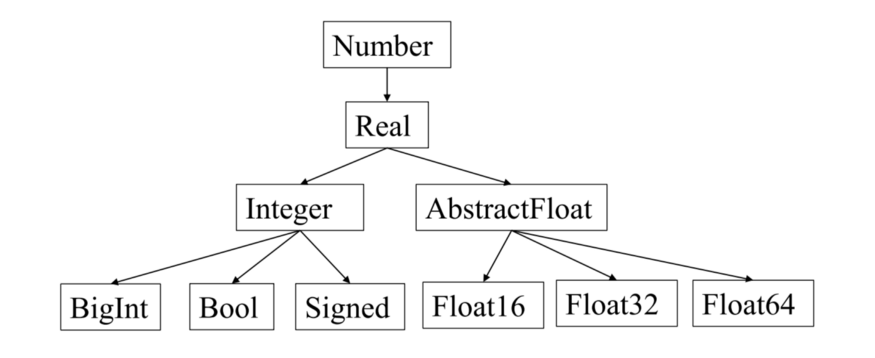
以及
Complex{T<:Real} <: Number
Rational{T<:Integer} <: Real
Irrational{sym} <: AbstractIrrational
5. 原始类型
原始类型(primitive type)是由 bit 组成的具体类型.Julia 可以自定义原始类型.定义原始类型的格式为
primitive type 类名 比特数 end
primitive type 类名 <: 父类名 比特数 end
primitive type Float16 <: AbstractFloat 16 end
primitive type Float32 <: AbstractFloat 32 end
primitive type Float64 <: AbstractFloat 64 end

primitive type Bool <: Integer 8 end
primitive type Char <: AbstractChar 32 end

primitive type Int8    <: Signed   8 end
primitive type UInt8   <: Unsigned 8 end
primitive type Int16   <: Signed   16 end
primitive type UInt16  <: Unsigned 16 end
primitive type Int32   <: Signed   32 end
primitive type UInt32  <: Unsigned 32 end
primitive type Int64   <: Signed   64 end
primitive type UInt64  <: Unsigned 64 end
primitive type Int128  <: Signed   128 end
primitive type UInt128 <: Unsigned 128 end
6. 复合类型
复合类型(composite) 类似于 C++ 中的 struct
struct Foo
    bar # 抽象类型是 Any
    baz::Int
    qux::Float64
end
foo = Foo("Hello, world.", 23, 1.5) # 叫做 constructor
fieldnames(Foo)
要获取成员的值,用 foo.bar, foo.baz, foo.qux 等.用 struct 声明的复合类型值在生成后就不能被改变.如果 struct 里面有矩阵等,那么矩阵元仍然是 mutable 的(没有 lower level const).
如果要支持成员改变,那么用 mutable struct 来声明即可.mutable struct 通常存在 heap 中而不是在 stack 中.
7. Type Unions
IntOrString = Union{Int, AbstractString}
1 :: IntOrString
"Hello!" :: IntOrString
1.0 :: IntOrString # 异常
<: 有什么区别?一个类只可能有一个非 Union 的母类,如果一个函数的参数想要支持两个母类不同的类怎么办?那就用 Union 即可.
另外一个应用的例子是 Union{T, Nothing} 作为函数参数,这样这个参数就可以忽略了.
8. 含参类型
复数类型 ComplexF16, ComplexF32 和 ComplexF64 是 Complex{Float16}, Complex{Float32} 和 Complex{Float64} 的别名.Complex 就是一个含参类型(parametric type)
例如
struct Point{T}
    x::T
    y::T
end
Point{Float64} 等都是合法的具体类型.
Point 本身是一个抽象类,是其具体类的母类
julia> Point{Float64} <: Point
true
julia> Point{AbstractString} <: Point
true
<: 相当于一个二元算符,输出 Bool.
例子:
function norm(p::Point{Real})
    sqrt(p.x^2 + p.y^2)
end
p = Point{Float64}(1.0, 2.0)
9. 含参抽象类型
含参抽象类型(Parametric Abstract Types) 例如
abstract type Pointy{T} end
struct Point{T} <: Pointy{T}
    x::T
    y::T
end
10. Pair
-
"abc" => 1.23的类型是Pair{String, Float64},令p = "abc" => 1.23,那么p.first和p.second分别可以获取两个变量. -
Pair同样是 immutable 的.
11. Tuple
Tuple 是函数参数列表的抽象.例如两个元素的 tuple type 类似于如下的含参 struct 类型
struct Tuple2{A,B}
    a::A
    b::B
end
julia> typeof((1,"foo",2.5))
Tuple{Int64, String, Float64}
julia> Tuple{Int,AbstractString} <: Tuple{Real,Any}
true

julia> Tuple{Int,AbstractString} <: Tuple{Real,Real}
false
-
t = (值1, 值2, 值3, ...)就是Tuple - 数组的元素类型必须相同,而
Tuple的元素类型可以不同 -
t = (1, "3.1", [1 2; 3 4])的类型是Tuple{Int64, String, Matrix{Int64}} - 数组的
length(),isempty(),reverse()同样适用于Tuple. -
t[i]获取某个元素,但不能对其赋值! Tuple 的元素永远不能改变! Tuple 类型是 immutable 的. - named tuple:
x = (a=2, b="abc"),类型为NamedTuple{(:a, :b), Tuple{Int64, String}}.然后可以使用x.a和x.b来获取元素. - 单个元素的 tuple 如
(1,),空 tuple 用()表示,类型为Tuple{}. -
(x,y) = (1,"ab")或者x,y = (1,"ab")会分别把元素赋值给x, y.这可以用于函数返回多个值.
12. 类似 C++ 的数据结构
Set
-
s = Set{Int64}()生成某种类型的空 set. -
s = Set([1,2,3])把数组变为Set(自动推导出类型Set{Int64}) -
push!(s, 123, 23, 532)添加若干元素. -
empty!(s)清空集合. -
in(123, s)查看某个元素是否存在 -
union!(s1,s2)计算并集,赋值给s1,s = union(s1,s2)计算并集,赋值给s.
Dict
-
d = Dict{key类型,Val类型}()创建一个字典(哈希表),也可以直接用Dict("ab"=>12, "bc"=>23)(会自动推导类型Dict{String, Int64}) -
push!(d, key1=>val1, key2=>val2)添加若干 entry,如果key已经存在,就覆盖val. - 添加新元素也可以用
a[key] = val. -
a[key]获取对应的val,如果key不存在则会出错. - 删除一个元素用
delete!(d, key) -
keys(d)表示所有存在的 key,类型是Base.KeySet{key类型, Dict{key类型, val类型}},不会复制值. -
vals(d)同理,类型是Base.ValueIterator{Dict{String, Int64}} - 要循环,可以
for (k, v) in d
   ...
end
13. Vararg Tuple Types
14. Named Tuple Types
15. Parametric Primitive Types
16. UnionAll Types
17. Singleton types
18. Type{T} type selectors
19. Type Aliases
使用等号.例如
# 32-bit system:
julia> UInt
UInt32

# 64-bit system:
julia> UInt
UInt64
This is accomplished via the following code in base/boot.jl:

if Int === Int64
    const UInt = UInt64
else
    const UInt = UInt32
end
20. Operations on Types
julia> isa(1, Int)
true

julia> typeof(Rational{Int})
DataType

julia> typeof(Union{Real,String})
Union

julia> typeof(DataType)
DataType

julia> typeof(Union)
DataType

julia> supertype(Float64)
AbstractFloat

julia> supertype(Number)
Any

julia> supertype(AbstractString)
Any

julia> supertype(Any)
Any
友情链接: 超理论坛 | ©小时科技 保留一切权利